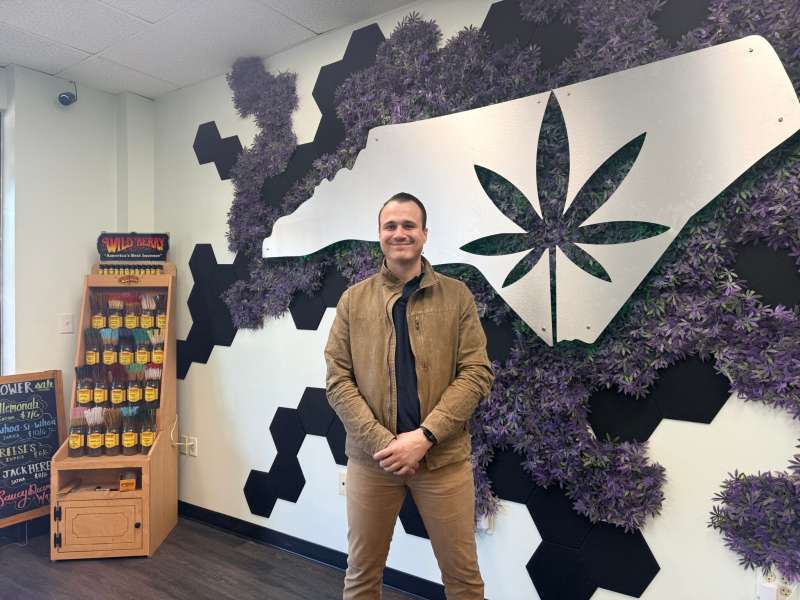
Chris Karazin started Carolindica with his brother and a friend in 2019, making homemade CBD products in a kitchen while working other jobs to pay the bills.
“I didn’t even get a paycheck until three years ago,” Karazin said.
Seven years later, the Raleigh-based company has grown into a multi-store hemp business with manufacturing operations and dozens of employees. New customers still walk through Carolindica’s doors every day.
Now, a looming change in federal law is forcing Karazin to reconsider the company’s future.
Beginning Dec.11, federal restrictions will sharply narrow which hemp-derived cannabinoid products qualify as legal. Congress approved the new federal regulations in 2025 as part of the tax cut and spending measure known as the One Big Beautiful Bill Act.
Under the new law, the only hemp products that will be legal are those with no more than 0.4 milligrams of THC compounds per consumer container, a threshold that could outlaw many products currently sold in stores.
The restrictions were originally scheduled to take effect in Nov. 2026, but Congress extended the deadline by a month.
One part of the law is still scheduled to take effect on Nov. 12. It excludes products that cannabis plants can’t naturally produce, including synthetic cannabinoids, from the federal definition of hemp, classifying them as marijuana.
For Karazin, the impending bans on synthetic cannabinoids and THC mean he’s rethinking the products the company can continue selling, how much inventory to carry and where to invest its money.
The federal restrictions follow years of rapid growth in the hemp industry, which proliferated after Congress legalized hemp production in 2018. North Carolina’s market has grown into a roughly $3 billion industry that employs about 16,000 people statewide.
But North Carolina hemp businesses are now preparing for the possibility that much of that market could soon disappear.
A business built around hemp
The federal changes could affect more than intoxicating products such as THC gummies and drinks. CBD products, which contain small amounts of THC and other natural compounds found in hemp, could also exceed the new limit.
The potential impact extends across the Triangle’s hemp retail market.
A report by Raleigh Dispensaries, which maintains a database of hemp retailers in the region, found that 79 of 82 shops it tracked across seven counties listed at least one product category that would be affected by the restrictions.
Jake St. Peter, the founder, said his report suggested more than 90% of the shops could be affected by the changes, and he’s been actively tracking how local businesses are preparing for the deadline.
“I think this is really going to be a serious blow to these businesses,” he said.
Some North Carolina hemp businesses are already closing as a result. Bloom Collective in Raleigh announced its closure on social media by the end of the month, saying new hemp regulations are putting “pressure on small businesses.”
Other retailers and farmers began preparing for the federal restrictions last year. Owners of Durham’s Redhead Hemp said the limit could affect all of their inventory, while a Buncombe County farmer said his farm lacked the equipment to shift to THC-free products.
For businesses that depend on those products, switching to a different line of merchandise isn’t straightforward.

Karazin said Carolindica is exploring supplements, functional mushrooms and other products that could offer alternatives if the restrictions go through as planned.
But he said many smaller hemp retailers won’t have the same options.
“Most companies are retail, distribution and e-commerce,” he said. “Those types of companies have no way of adapting at all.”
The restrictions would reach beyond the products sold on store shelves.
Farmers growing hemp for cannabinoid products could lose buyers if manufacturers reduce production. At the same time, merchandisers could have to find new markets for products or ingredients that comply with the federal law.
State lawmakers weigh additional restrictions on hemp
The federal deadline is not the only regulatory challenge facing North Carolina’s hemp industry.
State lawmakers have also debated legislation that would impose the same THC limit on hemp products as under the federal law, and would also ban the sale of even low-level hemp consumables, including CBD products, to people under 21.
The state Senate passed the measure last summer, saying it would be a backstop in case Congress decides to revise or delay the new federal law.
However, the House declined to take up the proposal during its August session under conflicting pressure from hemp businesses and law enforcement. House Speaker Destin Hall, R-Caldwell, said lawmakers needed more time to consider the issue and could reconsider it after the November elections.
Meanwhile, the state’s Advisory Council on Cannabis is moving in a very different direction.
The Council was created by Gov. Josh Stein, who is in favor of allowing a regulated cannabis market for adults only in North Carolina. The Council is developing recommendations for setting up such a market should legislators decide to allow it. Its final report is due to Stein by the end of the year.
A recent poll from researchers at Elon University of over 1,000 North Carolina adults found that 75% of respondents were in favor of legalizing cannabis for medical use, while 55% were in favor of legalizing it for recreational use.
Karazin said he supports regulations including age restrictions, child-resistant packaging and standardized laboratory testing.
He’s worried lawmakers will eliminate the entire legal hemp market instead of creating a strong regulatory framework that could allow his business to stay open.
“Regulation is what we need,” he said. “Prohibition is just hilarious regression.”